

16 Sep The Beauty Of Late Flowering Asters
One of my most favourite times of the year in the garden has to be September when the sun is a little lower in the sky and the early morning and late afternoon light extenuates the colours of late flowering perennials and shrubs. During garden consultations I often hear the complaint that after mid-summer most of the colour has gone from the garden and advice is asked about how to inject more visual interest at this time of year.
There are so many glorious plants to enjoy during September and I always strive to include as many as is appropriate in my plant designs. Not only do they extend the visual interest of the garden but they are a very important source of nectar for bees, butterflies and a host of additional wildlife.
Some of the most obvious plants are the Asters, a very large family of plants that are typically flowering from mid-summer to well into the autumn. Whether planted in bold drifts for maximum impact or intermingling with complimentary plants they are a total joy. Asters have been botanically grouped into Asters, Eurybia and Symphyotrichum as they have different characteristics. As the many different species and cultivars of Asters, Eurybia and Symphytrichums give varying heights and growth habits these plants can be used formally or informally and can be combined with other late flowering garden plants.
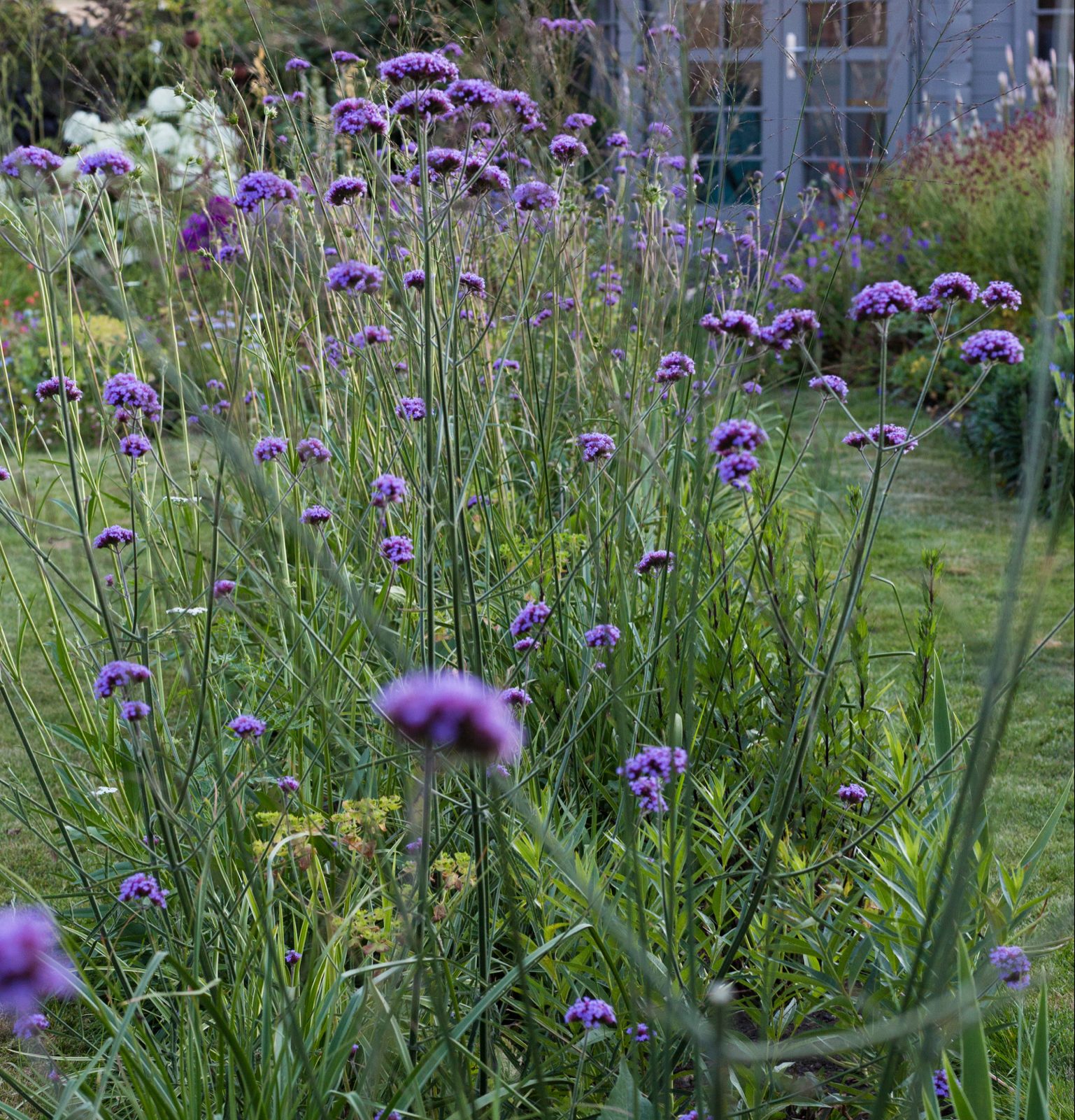
Aster xfrikartii ‘Monch’ is a particular favourite of mine as it produces lavender blue flowers over several weeks. It is quite upright in habit and is good in the middle of the border where it’s looser stems can intermingle with neighbouring plants such as Agastache rugosa ‘Black Adder’ and Geranium sanguineum as seen in the picture below.

Aster xfrikartii ‘Monch’, Agastache rugosa ‘Black Adder’ and Geranium sanguineum
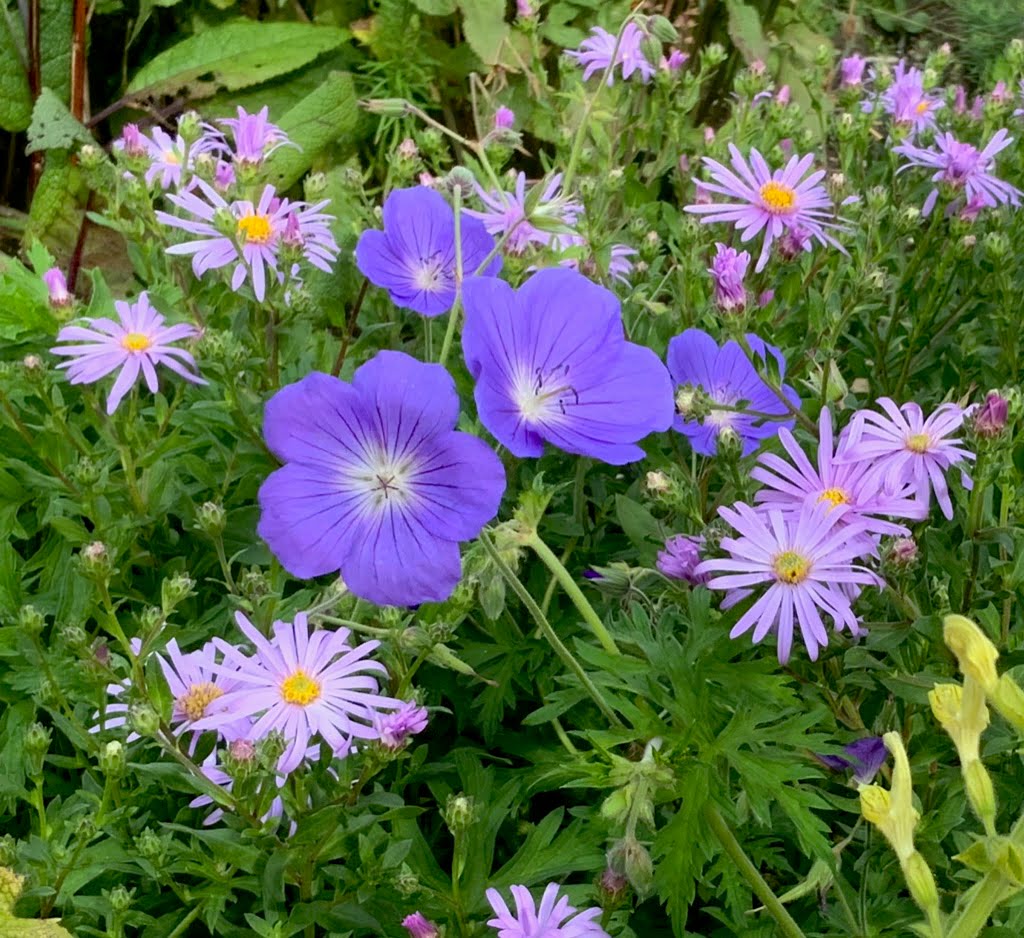
Aster xfrikartii ‘Jungfrau’ with Geranium ‘Rozanne’
Aster xfrikartii ‘Jungfrau’ is seen below contrasting beautifully with Geranium ‘Rozanne’. This Aster looks similar to ‘Monch’ but is a little more compact. Geranium ‘Rozanne’ has one of the longest flowering habits in the garden, flowering it’s heart out from April to the first hard frost. However, in order for it to still be looking neat by the end of summer and flowering prolifically it is important to cut it back to within a few cms of the ground in late June or early July. It often feels counterintuitive to be cutting it back at this point as it will be flowering well. However, if it is not cut back it will become very straggly, untidy and less floriferous. The gap left after cutting it back is only short lived as the regrowth of foliage is rapid especially if the plants are fed with a balanced fertilizer and watered well once done.
The deeper lilac/purple coloured Aster amellus ‘Veilchenkonigin’ combines well with late flowering perennials such as Anemone ‘Wild Swan’ and Astrantia ‘Buckland’ as can be seen below. These plants are all suitable for clay soil and a sunny or partly shady position. Astrantias are another perennial that will give a second flush of flowers if the old flowering stems are cut right back to the ground. The foliage can also be cut back as this promotes the growth of new fresh foliage which will remain looking good until the onset of winter.

Aster amellus ‘Veilchenkonigin’, Anemone ‘Wild Swan’ and Astrantia ‘Buckland’

Symphyotrichum novi-belgii ‘Sandford’s White Swan with Sedum ‘Purple Emperor’’
One of my other favourite Asters is Symphyotrichum novi-belgii ‘Sandford’s White Swan’. I love soft white double flowers that slowly become tinged with pink as they mature. Planted with Sedum ‘Purple Emperor’ highlights this subtle change in colour delightfully.
In addition to the late summer colour that Asters offer they also attract wildlife into the garden. I just love watching my bees still feeding on these wonderful group of plants in the September sunshine. Below Aster amellus ‘King George’ is often alive with bees and other nectar feeding insects.

Aster amellus ‘King George’
If you would like to buy Asters, a visit to see Helen Picton at the wonderful Old Court Nurseries in Colwall, near Malvern is one of the best Aster specialist nurseries I have found. You can also enjoy a walk around their beautiful Picton Garden which showcases many, many of their wonderful Asters and complimentary perennials, shrubs and trees.
Sorry, the comment form is closed at this time.